OWNER'S PROJECT REQUIREMENTS
The 48th Keep
⚠️ DISCLAIMER:
This document is the Governing Law for the project. Contractors shall prioritize these Integrated Systems over standard trade practices. "That's not how we usually do it" is not a valid RFI.
Table of Contents
1. EXECUTIVE SUMMARY & CORE MANDATES
Vision & Design Philosophy
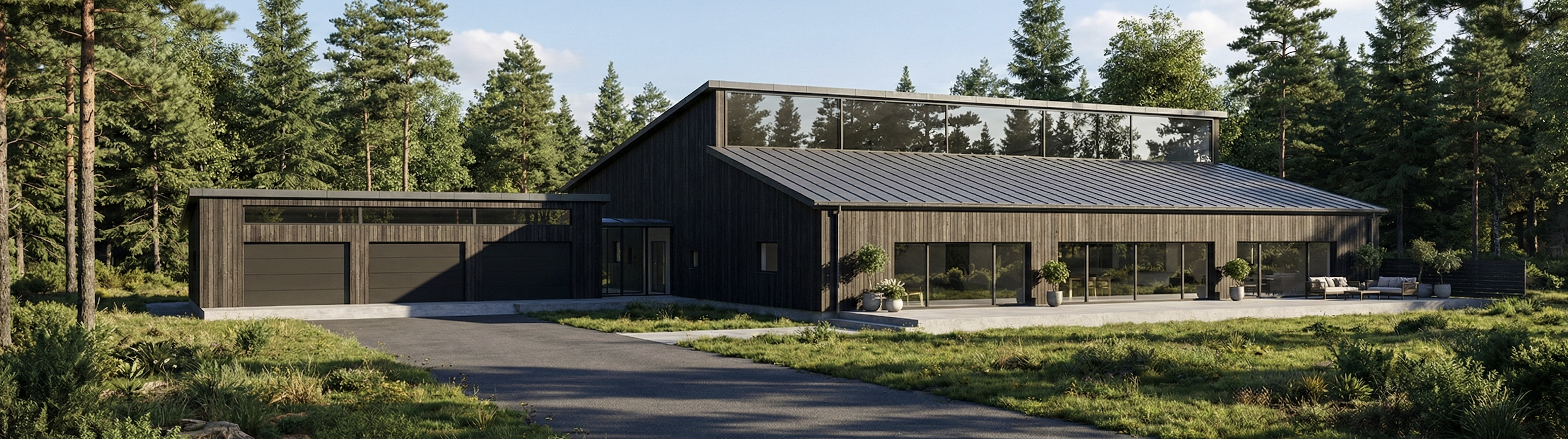
The 48th Keep Estate is conceived not merely as a high-end custom residence, but as a fully integrated, self-sustaining biological machine and a secure sanctuary capable of indefinite autonomous operation. The architectural form utilizes a compacted 'Concentric 48th Keep' footprint (approx. 115' x 115'). This squares the thermal envelope to minimize surface-area-to-volume ratio, reducing heat loss while creating a defensible central core. The 'Central Atrium Spine' acts as a 'lung' and internal street, pulled inboard to bring natural light and tropical air deep into the core of the square plan. The facility is designed to operate as a closed-loop system where waste streams (heat, air, water) are recaptured and valorized.
The "Construction Tare" Reality
The Owner acknowledges that to achieve the required ballistic and thermal resilience, the structure will inherently consume a larger percentage of the gross floor area than a standard stick-framed home.
- Structural Tax: The utilization of 12-inch Insulated Concrete Forms (ICF) and concrete shear cores will consume approximately 12-15% of the gross floor area.
- Target Metrics: The target gross building footprint is ~13,225 sq ft (115' x 115') to yield the desired ~7,600 sq ft of livable net conditioned space plus a fully functional 3,600 sq ft unconditioned atrium. This "tare" is an acceptable trade-off for the thermal mass and ballistic protection provided.
Regulatory & Tax Framework
To ensure long-term financial sustainability, the design must align with specific Idaho taxation definitions:
- Atrium Classification: The atrium shall be engineered and designated as an "Unheated Conservatory" (design temp 48°F via passive gain) for property-tax classification. It is a "buffer zone," not conditioned living square footage.
- Renewable Assets: All renewable energy systems (solar arrays, battery banks, geothermal heat pumps, borefields) shall be itemized separately on all schedules of values to claim the Idaho Code § 63-602JJ 10-year property-tax exemption.
- Agricultural Parcel: Civil site plan shall delineate a separate 10-20 acre agricultural/forest parcel eligible from day-1 for Idaho current-use taxation exemption.
Core Mandates
Operational Hierarchy (The "99/1" Rule)
- Standard Mode (99% of Time): Primary heating and cooling are achieved via a Ground Source Heat Pump (Geothermal). This system is hands-off, requiring zero user intervention, zero biomass handling, and maintaining hospital-grade climate control precision.
- Smart Hybrid Mode (Grid Failure / Winter Deficit): During extended winter outages (>24 hours), the system shifts to "Smart Hybrid" operation to balance Fuel Conservation against Physical Labor.
- Primary Heat (Wood): The Wood Hydronic Boiler activates as the primary thermal engine to conserve propane.
- Labor Offset (Propane/Geothermal): The Automation System shall retain the ability to run the Geothermal Heat Pump via the Propane Generator. This allows the Owner to "buy time off" from wood handling during nights or periods of fatigue, using the 1,000-gallon propane reserve to maintain slab temperature without physical labor.
Tropical Comfort
The interior environment must aggressively mitigate Seasonal Affective Disorder (SAD). The 3,600 sq ft, humidified, planted "Winter Garden" serves as the primary circulation core. Daily movement through the house compels exposure to full-spectrum light, high oxygen levels, and living greenery.
Constructability (The Winter Window)
The construction schedule must account for the limited alpine building season. The building envelope (Roof and Glazing) must be weather-tight before the first heavy snows to allow for conditioned interior work during the winter months.
Critical Performance Requirement
The system shall maintain ≥60°F interior, full Tier-1 critical loads, and minimum 48°F atrium for 14 consecutive days at -10°F ambient with zero solar input and no manual intervention.
2. SITE & CIVIL ENGINEERING
Objective: Aggressively terraform the site to manipulate local wind patterns and solar exposure, creating a synthetic micro-climate that passively manages snow accumulation and maximizes the critical southern view corridor.
Solar Access Mandate (The "Solar Cone")
Constraint: To ensure viable winter passive solar heating and greenhouse function, the "Solar Window" (defined as South ±30° azimuth) must remain absolutely clear of obstructions.
Clearing Spec: No vegetation, structures, or terrain features taller than 4 feet are permitted within 200 feet due South of the glazing. This "Solar Easement" must be physically cleared, de-stumped, and graded. The grading plan must account for the future growth height of any replanted shrubbery.
Excavation & Earth Sheltering
North Wing Strategy: North Elevation Strategy ("The Citadel Wall")
- Concept: To prioritize snow management and eliminate waterproofing risk, the North Wall shall remain fully exposed (standard grade).
- Snow Clearance: This maximizes the vertical drop from the "Ski Jump" roof eave to the ground (>15 ft), ensuring that shedding snow never accumulates high enough to bridge the roofline or vents.
- Frost Protection: Shallow Frost-Protected Foundation (SFPF) details are required per IRC R403.3 and ASCE 32-01 for Air Freezing Index (AFI) 2500. This includes:
- Full under-slab insulation: Minimum R-20 XPS or EPS foam boards (4-inch thickness, compressive strength ≥25 psi) installed continuously across the entire slab footprint, over a 6-mil polyethylene vapor barrier and 4-inch washed gravel capillary break/drainage layer. Insulation must be rated for below-grade use and protected from insect damage if necessary.
- Vertical insulation on foundation walls: Minimum R-10 XPS or EPS (2-inch thickness) extending from the top of the footing to 6 inches above finished grade, with protective coating or drainage board.
- Horizontal perimeter wing insulation: Minimum R-10 XPS or EPS (2-inch thickness) extending 40 inches outward from the footing edge (wider at corners: 60 inches for the first 8-10 feet along each side to address higher heat loss). Wings must be buried under backfill, sloped 2% for drainage, and integrated with site grading to prevent water pooling.
- Water Shed Umbrella: DELETED. No buried liner is required.
- Radon Mitigation: Due to the prevalence of granite bedrock in the region, a Passive Radon Stack connected to a permeable sub-slab depressurization layer (washed gravel) is required. The system must be "Active-Ready," pre-wired with a dedicated circuit in the attic for an inline radon fan should post-occupancy testing require active mitigation.
Geotechnical & Water
- Well Requirement: A minimum sustained yield of 5 GPM must be verified by a rigorous 72-hour pump test. If the primary aquifer yield is insufficient, a secondary well must be drilled, or a surface water filtration system with riparian rights must be engineered.
- Septic Resilience: Due to the risk of soil saturation during rapid spring snowmelt, the septic system must be an Advanced Treatment Unit (ATU) paired with a raised mound drainfield or pressurized drip dispersal system. Standard gravity-fed drainfields are prohibited.
SNOW MANAGEMENT & WIND ENGINEERING
- Drift Engineering: Roof Drainage Engineering: The roof shall be a Single-Slope Mono-Pitch draining South-to-North. The SEOR must calculate the impact load on the North Berm soil 'landing zone' to ensure the buried 'Umbrella' liner is not punctured by shedding ice.
- Design ground snow load minimum 100 psf (Bonner/Kootenai County extreme).
- Breezeway Drift Pocket: The SEOR must explicitly model the 20-foot hybrid breezeway (42-inch ICF pony walls with full-height panoramic glazing above) connecting the Garage and House as a "Drift Pocket." The roof structure in this zone acts as a snow trap and must be engineered for 250-300 psf to account for re-entrant accumulation and sliding snow impacts. Breezeway roof shall incorporate hydronic snow-melt coils tied to geothermal loop + structural load 400 psf. Pony walls shall provide thermal mass and insulation (R-50+ effective), with glazing oriented for south/west views.
- The Ski Jump: The North roof eave must extend a minimum 4 feet beyond the structural wall to launch snow clear of the foundation line.
- Hydronic Snow Melt: Limited to the Main Entry Pedestrian Path (Safety). The Garage Apron shall be cleared via mechanical plowing (F-350). The system shall NOT heat the driveway slab.
13. CRITICAL FLUIDS & FIRE SAFETY
13.1 Water Sovereignty
- Legal Verification: Contractor must verify Water Rights specifically for the "Fire Reservoir/Pool" volume. If the property lacks sufficient rights for the evaporative loss of a 25,000-gallon open surface, a Pool Cover Mandate (Section 13.2) becomes a legal requirement for permitting, not just a thermal one.
- Source: Deep Well (5 GPM Min) with Grid-Tied VFD Pump.
- Conditioning: Water must be purified, conditioned and re-mineralized. Calcite Neutralizer (pH 7.0-7.4) + Iron/Manganese Filter + 5-micron Carbon Block.
- Backup: Manual Bison Pump + 1,500-gallon gravity tank feeding Kitchen/Safe Room.
13.2 Wildfire Active Defense (The Wetting Loop)
- Reservoir: The South Infinity Pool 25,000 gal gunite, black PebbleTec "Midnight Blue" interior finish, 8-10 inch Gunite Shell with Interior-Applied Thermal Coating, automatic Safety Cover (Insulated Pool Cover with R-value > 10 with under-track rope system).
- Winterization: Submerged low-velocity pump (24/7) + Geothermal dump load to prevent freezing.
- Pump: Independent High-Pressure Fire Pump (Honda GX commercial series).
- Distribution: Roof Monitor Impact Sprinklers and Perimeter Standpipes.
- Automated hard-cover shall include crank-rod override sockets (robot-grip compatible) on both ends for power-failure manual closure.
- The pool shall be engineered and certified as primary fire-suppression reservoir for ISO Class-2 (or better) wildfire rating credit.
14. IT & COMMUNICATIONS ARCHITECTURE
- Backbone: Cat6A + Single-mode Fiber (OS2) for all exterior runs.
- WAN Redundancy: Starlink High Perf (Primary) + Starlink Standard (Secondary/Mast) + Cellular Gateway (Failover).
- Power: Rack on dedicated Double-Conversion Online UPS sized +20% to handle robot OTA update spikes.
15. LOGISTICS & MAINTENANCE
- Spare Parts: "One-for-One" protocol. Three complete spare wet-rotor cartridges for circulator pumps.
- Firewood Protocol: All firewood shall be cut to 20" ± 2" and split to ≤ 6" diameter for robot handling.
- Analog Redundancy: Fireproof Binder containing printed "Paper Twin" of all manuals.
16. ROBOTICS AUTONOMY INTEGRATION
Objective: Delegate 60-80% of repetitive labor to humanoid robotics (Tesla Optimus).
16.1 The "Analog Twin" Infrastructure (The Fiducial Layer)
Machine Vision is Primary. The cost of maintaining a physical fiducial layer over the life of the building is greater than the reliability gained. Rely on the Tesla Optimus's native, self-updating SLAM/AI systems for navigation, which are designed to improve over time.
16.2 Logistics Integration
- Charging: 3x Tesla Wall Connectors with inductive pads (if available) (North Mechanical, Garage, Solar Array) to reduce wear and integrate waste heat into geothermal loops.
- Winter Dock: The Robot Alcove in the Mechanical Room must include a Heated Winter Dock extension (>40°F) to maintain battery temp.
- Environmental Limits: Robot operations strictly limited to indoor tasks when ambient temps drop below 0°F.
- Fail-Safes: All automated systems (Pool Cover, Boiler Feed, Feed Drums) must retain manual mechanical overrides accessible by both human hands and robot end-effectors (standardized hex or handle geometry).
- Faraday Cage: Dedicated 6 x 6 ft grounded Faraday cage in Mechanical Room for robot storage and critical spare electronics during severe geomagnetic events.
16.3 Operational Profiles (Lifecycle Management)
The Automation System shall feature user-selectable "Global Modes" to adapt the facility's behavior to the Owner's physical capacity and occupancy status.
A. Vacation Mode ("The Deep Sleep")
Intent: Long-term absence (>30 days). Objective is asset protection and energy stasis.
- Thermal Setpoint: Global setback to 55°F. (Warm enough to prevent condensation/freezing, cool enough to minimize energy burn).
- Water Security: The Main Water Service Valve (Moen Flo/Phyn) shall CLOSE automatically. A dedicated bypass line shall remain open strictly for the Atrium Irrigation and Hydronic Makeup water, monitored by a secondary flow sensor with a "High Flow" (Pipe Burst) instant-kill trigger.
- Security: "Citadel Protocol." Night Shields: Deployed 24/7 on North/East/West glazing. South Glazing: Electrochromic glass set to 0.09 SHGC (Dark) to prevent solar overheating while HVAC is in setback.
- Atrium Logic: Shifts to "Dormancy." Lighting: Maintenance DLI (5-10 mol) only. Humidity: Reduced to 50% to minimize fungal risk while unmonitored.
- Robot Patrol: Frequency increases to 6x daily. Video summaries ("The Daily Roll-Up") sent to the owner's cloud dashboard.
B. Shutdown Protocol ("Legacy Mode")
Intent: A "De-Escalation" of facility complexity for aging-in-place or reduced physical capacity.
Authorization: This mode explicitly overrides the "Efficiency First" mandates of this OPR in favor of "Simplicity First."
Labor Bypass (The "Blue Collar" Override):
- Heating: The system permanently authorizes Propane/Geothermal as the Primary Heating Source. The Wood Boiler is relegated to "recreational use only." The Owner is relieved of the physical obligation to load biomass.
Bioshelter Shutdown:
- Food Production: The "Harvest Kitchen" and "Zone 1" hydroponics are decommissioned.
- Atrium Status: Reverts to "Ornamental Garden". Lighting targets reduced to maintenance levels. Pruning alerts suppressed.
Concierge Routing:
- Technical alerts (Filter changes, Pump failures, Chemistry imbalance) are no longer sent to the Owner.
- Routing: Alerts are automatically dispatched to a pre-designated "Facility Management Proxy" (Local HVAC/Plumbing service provider) via email/SMS. The house calls the plumber for you.